While the festive season (or any family gathering) brings many challenges, physically, financially, socially, emotionally and cognitively, here is a simple guide to making the most out of our brain states during these coming weeks.
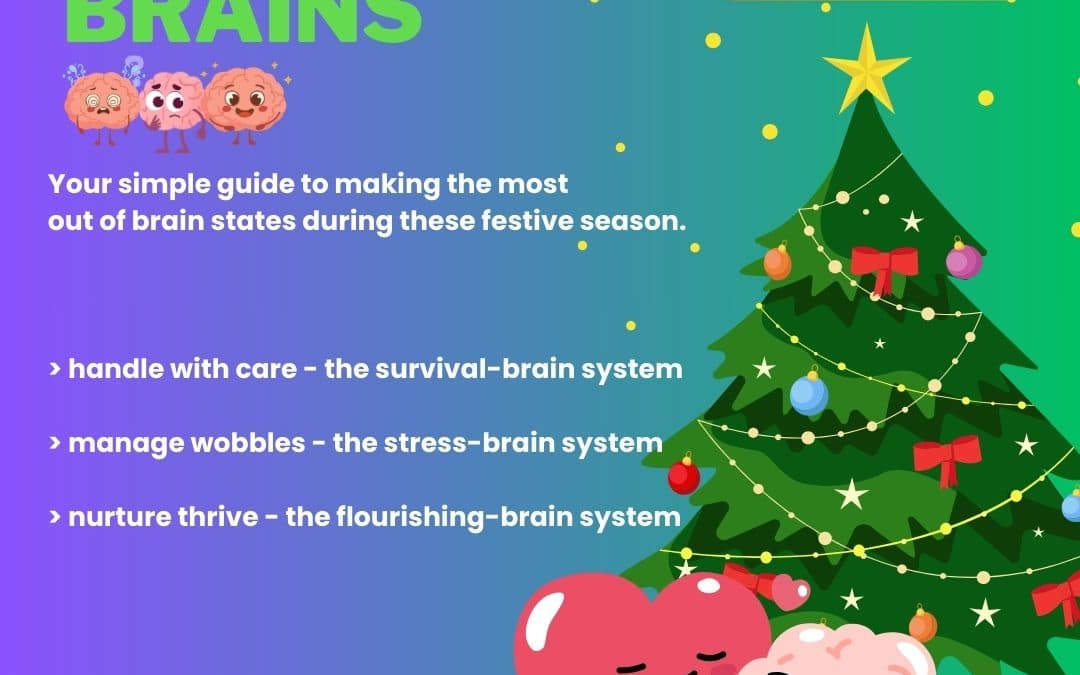
Three essential brain states play a significant role in shaping perceptions and responses to the world:
> the survival brain system – handle with care
> stress brain system – wobbles most likely
> thrive brain system – gold standard
NO1: Handle With Care! The first and most primitive brain state (which hopefully you won’t have to deal with) is the survival system; focused on prioritising physical safety through instinctual reactions such as fighting, fleeing,
or freezing.
Individuals in this state have rigid or flaccid personal boundaries and are driven by impulses to seek immediate (and often erroneous) comfort and security.
This brain state navigates life through a lens of hostility, oppression, and threats, leading to a belief in being a victim of life’s cruelties.
What you can do:
Unconditional acceptance of ‘what is’
Talk in present tense – avoid reminiscing or future projecting.
Reference agreeable sensory experience (e.g. “look at those red berries, there are carol singers on the radio, this tablecloth feels creased, the candle smells of pine, can you taste the ginger?”)
Avoid discussing (or redirect) perceptions and opinions of the wider world (especially politics).
Share happy news (not complaints) about family members.
Make no attempt to convince them their reality could/should be otherwise.
Be a beacon of inspiration by proving that you are physically, emotionally, and mentally safe to be around.
Play simple non-competitive games.
Encourage rest, hydration, nutrition, connection.
NO2: Gold Standard! By stark contrast, the thrive system, focuses on growth and development in physical, emotional, and cognitive aspects. Individuals in this state are open to constructive interactions with others, engage in self-reflection and adaptability to life’s challenges.
Curiosity becomes a driving force that propels them towards exploring their full potential, testing new possibilities, and amplifying positive outcomes. And a sense of purpose with passion for self-mastery, serve as the guiding principles of thriving in this brain state.
What you can do:
Experience a wide range of genuine emotions that include joy, peace, excitement, anticipation.
Be present to and enhance, a wide range of sensory experiences.
Exchange happy memories of the past and hopes for the future.
Play games that invite collaboration and a little competition.
Bathe in feelings of joy, laughter and loving.
NO3: Wobbles Most Likely! Somewhere in-between the first two brain states is the all too familiar stress-brain system. This state puts a premium on emotional safety by seeking connections with people and aspects of life aligning with their own emotions and experiences.
Stressed individuals seek ‘sameness’ and often compare themselves to others to establish ‘difference’ which can lead to a distorted elevation (or collapse) of self that feels familiar.
Personal boundaries may fluctuate between being overly stiff and non-existent. A lot of energy is required to filter reality for confirmation of personal control in a world of hostility.
What you can do:
Deal with difficult people through self-reflection (own/adjust your part to play in conflict – aim for win-win).
Make the environment a sensory smorgasbord that stimulates great brain chemistry by enhancing and drawing attention to positive, festive sights, sounds, smells, tastes and activities.
Look for ways to facilitate/accommodate different world views.
If troubles are aired, keep your own side of the street clean so you don’t become contaminated by collective stress.
Avoid trying to convince anyone of anything – this is the season of peace and goodwill to all (a positive brain pathways to strengthen).
Don’t try to predict a future that has many possible outcomes! Instead, drive your best life by conscious, creative curation. Aim for thrive.
Devil is in the detail, so take a long view of the bigger goal – adaptability to life’s challenges.
Make curiosity your star mindset – explore best potential relationships and amplify the joys of positive outcomes.
Make your sense of purpose to be masterful in thriving.
In this podcast, Happy Brain Trainers Kay Cooke and Tracey Hutchinson (British Horse Society coach) discuss the importance of language in riding instruction, emphasising the impact of both rider and coach’s words. They highlight that negative instructions, such as “don’t grip with your legs,” can inadvertently prompt the opposite behaviour. The conversation stresses the effectiveness of positive, clear instructions like “sit up straight” and the significance of tonality. They also explore the concept of NLP presuppositions, where phrasing instructions in a positive manner can influence the rider’s mindset and performance. The discussion touches on the psychological aspects of riding, including the rider’s internal language and the horse’s response to the rider’s state of mind.
“We need 4 hugs a day for survival, 8 hugs a day for maintenance, and 12 hugs a day for growth” Virginia Satir
World-renowned family therapist.
This quote emphasises the importance of physical touch to help us feel safe, belonging, calm, connected and trusting. All of which boost individual immune systems and support community wellbeing. Hugs help release a cascade of thrive neuro-chemistry, especially oxytocin.
Hugs are fuel for better family and social systems; a great investment for our children’s children’s children …
But what about people who are hug deficient, socially isolated, emotionally lonely? What can we do to boost this neuro-chemical that is so essential for wellbeing?
Can we bio-hack an oxytocin boost?
Yes, we can.
6 tips to optimise oxytocin levels for yourself and for others:
Come Find Me
Resonating
Gifting
Petting
H-Art
H-Artifacts
Come Find Me Check out the work of neuroscientist Jill Bolte Taylor who, upon regaining consciousness after a stroke, observed that medical staff and visitors were functional but detached. She describes feelings of being trapped inside her mind and body and yearning to plead: ‘Here I am, I’m in here, come find me…’
I’ve heard this yearning from many clients.
You can do that for someone (go find them…) by taking off your critical lens, your analytical thoughts and judgements and simply being present with the wonderful specimen of a human being who is being alive right in front of you.
Resonating
Whether you’re talking to someone face to face, over the garden fence or through social media, giving your full, undivided attention is a gift for both parties. This boosts a mind-body sensation where you feel a powerful energetic plug-in to another human.
Learn to tune up ALL your senses to be present with and for a significant other person, with your own whole being. It may take a bit of practice to let go of thoughts that try to convince you that your inside world is more valid than what’s occurring in the space between you, but try it. And feel the difference.
Gifting
Boost your neurochemistry of connection to and with others when you do things without the need for recognition. Make the art of authentic giving your new superpower. It can be:
A bloom from the garden, a special meal, a heartfelt gesture.
A gesture, hug, cuddle, caress, hand hold.
A compliment, giggle, smile.
A helping hand with chores or running a bath for someone.
Petting
Pets mirror our moods and petting them soothes stress levels in both parties by lowering cortisol and blood pressure while boosting oxytocin. Look up the data on Pets As Therapy! Soft, smooth rhythmic petting – especially skin-on-skin – stimulates calming neurochemistry and slower brain waves.
H-Artful
Draw, paint or colour heart shapes on stones, on paper, on anything! You are (re)setting your sub-conscious mind to loving associations. Kids do this naturally –when did you stop?!
Visualise your heart as a personal space for your loved ones to nestle, where you keep them cozy, warm and wrapped up in your purest love.
Play a game with your where you roll a dice and describe the sensations of feeling love in that number of words. For example, rolling the number 3 would lead to describing some sensations of love in three words, such as warm, rising, pink.
H-Artifacts
Look at your household artefacts and subjectively measure the level of associated emotional that your brain has anchored. Based on this ‘audit’ you can re-arrange common areas so that your daily view of pictures, photos, ornaments etc, maximise your happy chemicals. What’s the first and last thing you look at each day?
Dedicate time to looking through photos that bring back happy memories of times shared with loved ones. Celebrate these feelings.
Working with young people (and their parents) means helping them understand the basics of designing a future self who is calm, confident, enjoying successful relationships, and is thankful for learning some basic secrets of happiness.
This process applies to any age!
“It is impossible to control any goal that requires other people to change.”
Case study: Lonely Lana
Moving schools had been a good decision for 14-year-old Lana but had left her yearning for her old group of pals. But her mind had played tricks on her, recalling the past in a kinder light, yet in truth, she had been quite unhappy with them. The NEW friendship group felt impermeable, and she came to see me asking for help with ‘social exclusion’.
We established that a couple of girls in the group were being really kindand friendly towards her, but this didn’t satisfy Lana and she found herself:
Dismissive of easily available friendships.
Keeping her sights fixed on getting attention from the big personalities.
Negatively mind-reading the new group’s intentions.
Negatively interpreting the body language of certain group members.
Feeling awkward and self-conscious
Fantasising that the old school friendship group was perfect.
We summarised our initial discussion in terms of her:
THOUGHTS – the group was unsure about her and viewed her with suspicion.
FEELINGS – self-conscious, unhappy, and awkward.
BEHAVIOUR – wanting to withdraw from the group.
Delving deeper into her thinking patterns she soon revealed some fundamental beliefs that were triggering her own unhappiness.
Trigger thoughts included:
“Making new friends is hard work and tiring”
“Why don’t they? …. (act the way I want them to act)”
“I have lost my perfect old friends”
These thoughts triggered her ‘feel-bad’ strategy.
She ran this strategy in her mind ‘on-repeat’.
Neural plasticity meant that those self-harming thoughts became automatic – because she had practiced paying attention to them.
Soon into our session, Lana realised that her true (unconscious) friendship goal had been to be the popular one amongst a large group of girls. But she didn’t yet realise that goal was impossible to achieve since it required:
Exhausting effort to try to change the opinions and behaviours of others.
The others to prioritise her needs above their natural ordering.
I invited her to understand that it is impossible to control any goal that requires other people to change. Trying to do that had been exhausting and frustrating, wasting energy and leading to disappointment in others and (self) generating feelings of unhappiness.
EXPLORING SOLUTIONS
I wondered if Lana could amend her friendship goal to “I want to feel relaxed and authentic around new people”. That would require her to expect nothing back from them, just to be curious and interested in the evolving relationships.
After all, a goal like this means being in charge of a goal you can actually control!
EXPERIMENT
We worked hypnotically to visualise Lana pitching up at school, looking for fun people to get to know while feeling relaxed, interested, humorous and happy. This imprinted a new neurological template which she could practise (through neural plasticity) until it became her autopilot.
FEEDBACK
We reframed her thinking so that SHE could reflect on, and positively adjust, her personal thoughts, feelings, and behaviours – it’s an inside job!
SKILLS
I taught her techniques for self-regulating wayward feelings.
FEED FORWARD
We looked through time to visit her future-self. The person who is calm, confident, enjoying a range of successful relationships, and thankful for learning some basic secrets of owning next-generation happiness.



Recent Comments