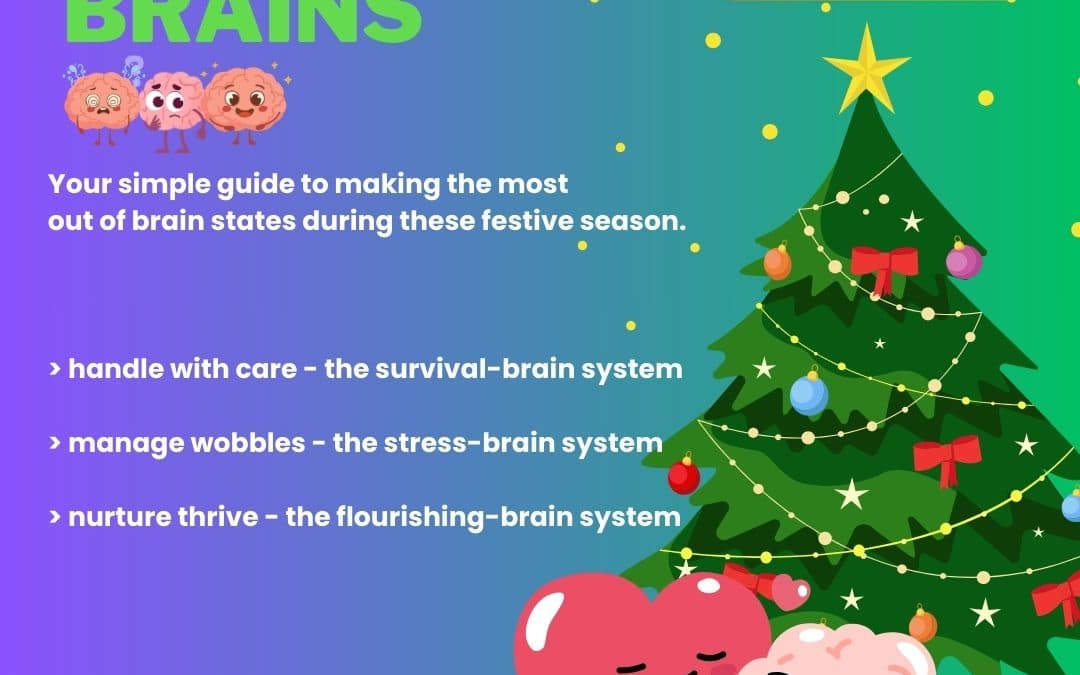
While the festive season (or any family gathering) brings many challenges, physically, financially, socially, emotionally and cognitively, here is a simple guide to making the most out of our brain states during these coming weeks.
Three essential brain states play a significant role in shaping perceptions and responses to the world:
> the survival brain system – handle with care
> stress brain system – wobbles most likely
> thrive brain system – gold standard
NO1: Handle With Care! The first and most primitive brain state (which hopefully you won’t have to deal with) is the survival system; focused on prioritising physical safety through instinctual reactions such as fighting, fleeing,
or freezing.
Individuals in this state have rigid or flaccid personal boundaries and are driven by impulses to seek immediate (and often erroneous) comfort and security.
This brain state navigates life through a lens of hostility, oppression, and threats, leading to a belief in being a victim of life’s cruelties.
What you can do:
Unconditional acceptance of ‘what is’
Talk in present tense – avoid reminiscing or future projecting.
Reference agreeable sensory experience (e.g. “look at those red berries, there are carol singers on the radio, this tablecloth feels creased, the candle smells of pine, can you taste the ginger?”)
Avoid discussing (or redirect) perceptions and opinions of the wider world (especially politics).
Share happy news (not complaints) about family members.
Make no attempt to convince them their reality could/should be otherwise.
Be a beacon of inspiration by proving that you are physically, emotionally, and mentally safe to be around.
Play simple non-competitive games.
Encourage rest, hydration, nutrition, connection.
NO2: Gold Standard! By stark contrast, the thrive system, focuses on growth and development in physical, emotional, and cognitive aspects. Individuals in this state are open to constructive interactions with others, engage in self-reflection and adaptability to life’s challenges.
Curiosity becomes a driving force that propels them towards exploring their full potential, testing new possibilities, and amplifying positive outcomes. And a sense of purpose with passion for self-mastery, serve as the guiding principles of thriving in this brain state.
What you can do:
Experience a wide range of genuine emotions that include joy, peace, excitement, anticipation.
Be present to and enhance, a wide range of sensory experiences.
Exchange happy memories of the past and hopes for the future.
Play games that invite collaboration and a little competition.
Bathe in feelings of joy, laughter and loving.
NO3: Wobbles Most Likely! Somewhere in-between the first two brain states is the all too familiar stress-brain system. This state puts a premium on emotional safety by seeking connections with people and aspects of life aligning with their own emotions and experiences.
Stressed individuals seek ‘sameness’ and often compare themselves to others to establish ‘difference’ which can lead to a distorted elevation (or collapse) of self that feels familiar.
Personal boundaries may fluctuate between being overly stiff and non-existent. A lot of energy is required to filter reality for confirmation of personal control in a world of hostility.
What you can do:
Deal with difficult people through self-reflection (own/adjust your part to play in conflict – aim for win-win).
Make the environment a sensory smorgasbord that stimulates great brain chemistry by enhancing and drawing attention to positive, festive sights, sounds, smells, tastes and activities.
Look for ways to facilitate/accommodate different world views.
If troubles are aired, keep your own side of the street clean so you don’t become contaminated by collective stress.
Avoid trying to convince anyone of anything – this is the season of peace and goodwill to all (a positive brain pathways to strengthen).
Don’t try to predict a future that has many possible outcomes! Instead, drive your best life by conscious, creative curation. Aim for thrive.
Devil is in the detail, so take a long view of the bigger goal – adaptability to life’s challenges.
Make curiosity your star mindset – explore best potential relationships and amplify the joys of positive outcomes.
Make your sense of purpose to be masterful in thriving.
As @thehappybraintrainer I help people empower their personal wellbeing and bite-sized chunks is so often the way to go!
So let’s go …
Neurochemicals are essential messengers in the brain that play a crucial role in regulating our moods, emotions, and cognitive functions. By learning how to influence the production of key neurochemicals, such as serotonin, GABA, oxytocin, dopamine, endorphin, and acetylcholine, we can nurture a healthier brain and cultivate a more fulfilling life.
There are said to be around 100 neurochemicals vital to our wellbeing, both for Survival and for Thrive, all ebbing and flowing in a multitude of combinations.
The 3 major stress chemicals are adrenaline, cortisol, and norepinephrine and they help to power fight or flight reactions, which is important in appropriate situations, but we don’t want them to dominate the quality of our brain chemistry.
My super 6 neurochemicals are no more important than the other 94, but they are listed here because they are well know, easy for you to research, and easy for us all to influence.
Serotonin
Often referred to as the ‘happiness molecule’. Essential for self- esteem and feeling calm. Promote through relaxation, deep breathing e.g. Balloon Breathing, meditation, bath soaks, and diet (e.g. good quality 85% cacao chocolate and herbs such as St. John’s Wort**)
GABA
This is known as nature’s Valium since it regulates anxiety by blocking or inhibiting stress chemicals. It also helps to support bodily movement. Promote through whole foods and vegetables, fermented foods, and herbs such as chamomile* and lavender*.
Oxytocin
Known as the hug hormone, this is essential for social bonding. Mothers and newborn babies are flooded with oxytocin (nature is very smart). Promote through skin touch e.g. hand holding, hugs, massage, cooperative activities, and herbs such as chamomile* and lavender*.
Dopamine
The feel-good reward for taking action, sets up motivation circuits. Promote through novelty, music, sport, dairy, omega 3, nuts and protein rich foods.
Endorphin
Nature’s ‘high’ that provides an analgesic effect. Promote through walking, dancing, exercise and laughter.
Acetylcholine
Helps to support memory signals, especially through deep restorative sleep. Supports movements. Promote through choline foods (eggs, fish, meats and whole grains) and herbs such as sage* and rosemary*.
*I use herbal teas and essential oils to help prepare myself – or my environment – for the task ahead.
I may want to calm my nervous system (lavender or chamomile), liven it up (bergamot or lime), or help memory (rosemary or sage).
Note – This is not prescriptive; you should always consult a health professional or medical herbalist before making
dietary changes. ***St John’s Wort is known to interact with medication – please seek advice before using.
Did you know?
o Phytochemicals in lavender inhibit sympathetic nervous system & bind with GABA receptors.
o Phytochemicals in chamomile bind with GABA receptors.
In this podcast, Happy Brain Trainers Kay Cooke and Tracey Hutchinson discuss the integration of Happy Brain techniques with equestrian coaching. Tracey, a British Horse Society coach, explains how Happy Brain principles enhance rider-horse relationships by focusing on mutual understanding and connection. They highlight the shift towards a more compassionate and horse-centred approach in equestrian training, driven by social media and public scrutiny. Tracey emphasises the importance of self-awareness, body awareness, and emotional regulation for both riders and horses. They also touch on the Foundations for Excellence in Equestrian Coaching (FEEC) program, which enhances the skills for simplicity, fun, and behavioural flexibility in coaching.
A busy and fruitful month of May has passed, and I am excited to share with you some key reflections that may resonate with and inspire your personal wellbeing journey.
**Like Attracts Like**
In mid-May, I had the pleasure of assisting in a Neuro Hypnotic Repatterning program in Italy with Dr. Richard Bandler. This program delves into immersing the mind-body in positive chemistry, unlocking the brain’s creative solutions centre. This experience of being part of a super high-calibre team, highlights the importance of surrounding oneself with excellence and raising personal standards of responsibility.
*Reflection:*How can you seek out and integrate systems of excellence in your daily life?
**Feedback to Feedforward**
Throughout May, I delved into personal metrics to assess my growth, including staying grounded in chaotic environments, embodying calm and confident states, and maintaining centeredness. Taking responsibility for the feedback loop of my mind-body connections has significantly improved my life.
*Reflection:* What personal metrics are you using to enhance your well-being and growth?
**Calibrating**
Whilst engaged in seminars in Italy and London during May, many discussions centred around techniques for family stability. We believe and teach that true flourishing requires the understanding of family dynamics, rather than simply managing symptoms. As a result, I’m excitedly making plans to reintroduce live workshops that support families in navigating their unique systems.
*Reflection:* How can you deepen your understanding of your family system to foster growth and stability?
**Collaborating**
The theme of collaboration resonated strongly among my peers in May, emphasising the value of authentic partnerships driven by shared values and skills. In times of rising consciousness, genuine connections and alliances are most definitely key to fostering growth and success. That means less shallow partnerships for economic or glamour gains.
*Reflection:*Since none of us are as smart as all of us, how do you align with others on or above your wavelength, to incubate and propagate mutual growth and success?
May has been a month of growth, reflection, and connection. Perhaps my insights have tickled yours? If so, please share what you apply to your personal journey for enhancing well-being and happiness. Kx
This month’s focus is more on the neurotransmitter Serotonin, with an anecdote is about a 12-year-old client who set up his own empirical study of the effects of boosting serotonin.
Having taught Balloon Breathing to 12-year-old Jake, he still wasn’t convinced that he could reproduce the ‘in the moment relaxation’ I had induced in him.
You see his daily stress around homework and revision was grinding him down and generalising in other areas of life.
So, we made a plan for him to set up his own trial of the effects of both ‘preparing’ and ‘not preparing’ his body and mind for the tasks of homework and revision.
He was blown away with the results of Balloon Breathing and Body Balance (two techniques from our Calm Confidence Kit). Not only did he feel more relaxed while on task, but his grades improved AND he chose to practice these techniques during school tests. What impressed me most was his use of an Excel sheet to plot his own evidence!
Because that’s the secret to happy living – setting up your own bio-feedback system for self-improvement success. After that, it doesn’t take long for the mind to start trusting the positive direction of thrive sensations.
Jake boosted his serotonin levels. And to me that’s literally Sunshine Thinking because he learned to make a better decision about ways to brighten his days!
You probably know that serotonin is often referred to as the happiness molecule and is a neurotransmitter that can be boosted by relaxation, exercise, diaphragm breathing, and many other things, including diet. Did you know that 90% of your body’s serotonin is created and stored in your gut, reinforcing the importance of good gut health!
Here’s a short exercise that helps your neuro-bio-physiology relax. Do your own calibration and feel the effects of doing this and remember that it is easily teachable to young ones (e.g. preparing their brains for doing homework or tests).
Hold up your non-dominant hand (NDH) palm facing you.
Point to it with the other hand.
Place your pointing finger on the base of your NDH wrist.
Slowly trace up and down each of your fingers, noticing the sensations of skin on skin, in both directions.
Swap hands and calibrate any difference.
Tune into the physical sensations that your nervous system is providing you with.
Continue very slowly until you feel more relaxed.
To deepen the practice, you can bring awareness to your breath and keep doing the finger slide while coordinating a slow in-breath as you ascend each finger and a long out-breath with each descent. Hopefully you have now mindfully engaged your Parasympathetic Nervous System!
Note: this exercise activates both right and left brain hemispheres, boosts THRIVE neuro-chemicals like serotonin and oxytocin, and helps bring brain waves into Alpha wave coherence.



Recent Comments