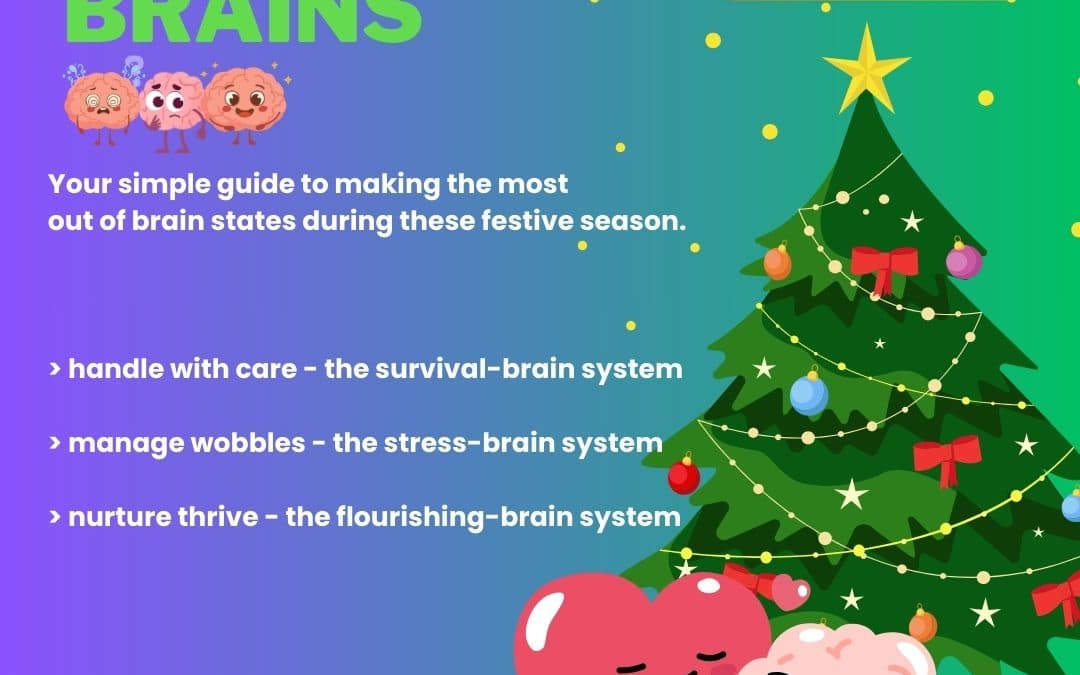
While the festive season (or any family gathering) brings many challenges, physically, financially, socially, emotionally and cognitively, here is a simple guide to making the most out of our brain states during these coming weeks.
Three essential brain states play a significant role in shaping perceptions and responses to the world:
> the survival brain system – handle with care
> stress brain system – wobbles most likely
> thrive brain system – gold standard
NO1: Handle With Care! The first and most primitive brain state (which hopefully you won’t have to deal with) is the survival system; focused on prioritising physical safety through instinctual reactions such as fighting, fleeing,
or freezing.
Individuals in this state have rigid or flaccid personal boundaries and are driven by impulses to seek immediate (and often erroneous) comfort and security.
This brain state navigates life through a lens of hostility, oppression, and threats, leading to a belief in being a victim of life’s cruelties.
What you can do:
Unconditional acceptance of ‘what is’
Talk in present tense – avoid reminiscing or future projecting.
Reference agreeable sensory experience (e.g. “look at those red berries, there are carol singers on the radio, this tablecloth feels creased, the candle smells of pine, can you taste the ginger?”)
Avoid discussing (or redirect) perceptions and opinions of the wider world (especially politics).
Share happy news (not complaints) about family members.
Make no attempt to convince them their reality could/should be otherwise.
Be a beacon of inspiration by proving that you are physically, emotionally, and mentally safe to be around.
Play simple non-competitive games.
Encourage rest, hydration, nutrition, connection.
NO2: Gold Standard! By stark contrast, the thrive system, focuses on growth and development in physical, emotional, and cognitive aspects. Individuals in this state are open to constructive interactions with others, engage in self-reflection and adaptability to life’s challenges.
Curiosity becomes a driving force that propels them towards exploring their full potential, testing new possibilities, and amplifying positive outcomes. And a sense of purpose with passion for self-mastery, serve as the guiding principles of thriving in this brain state.
What you can do:
Experience a wide range of genuine emotions that include joy, peace, excitement, anticipation.
Be present to and enhance, a wide range of sensory experiences.
Exchange happy memories of the past and hopes for the future.
Play games that invite collaboration and a little competition.
Bathe in feelings of joy, laughter and loving.
NO3: Wobbles Most Likely! Somewhere in-between the first two brain states is the all too familiar stress-brain system. This state puts a premium on emotional safety by seeking connections with people and aspects of life aligning with their own emotions and experiences.
Stressed individuals seek ‘sameness’ and often compare themselves to others to establish ‘difference’ which can lead to a distorted elevation (or collapse) of self that feels familiar.
Personal boundaries may fluctuate between being overly stiff and non-existent. A lot of energy is required to filter reality for confirmation of personal control in a world of hostility.
What you can do:
Deal with difficult people through self-reflection (own/adjust your part to play in conflict – aim for win-win).
Make the environment a sensory smorgasbord that stimulates great brain chemistry by enhancing and drawing attention to positive, festive sights, sounds, smells, tastes and activities.
Look for ways to facilitate/accommodate different world views.
If troubles are aired, keep your own side of the street clean so you don’t become contaminated by collective stress.
Avoid trying to convince anyone of anything – this is the season of peace and goodwill to all (a positive brain pathways to strengthen).
Don’t try to predict a future that has many possible outcomes! Instead, drive your best life by conscious, creative curation. Aim for thrive.
Devil is in the detail, so take a long view of the bigger goal – adaptability to life’s challenges.
Make curiosity your star mindset – explore best potential relationships and amplify the joys of positive outcomes.
Make your sense of purpose to be masterful in thriving.
Asma Jacob is a Happy Brain Coach and therapist specialising in neurodiversity.
In this Pod Chat, Asma discusses her journey of self-discovery and the challenges of being diagnosed with dyslexia, autism, and ADHD later in life. She emphasises the importance of getting the right support and best tools for neurodivergent individuals to thrive.
Asma also highlights the concept of masking, where neurodivergent people adapt to societal expectations, often leading to mental health issues. She explores the impact of sensory processing and the use of stimming for self-regulation.
In this recording you will hear inspiring client stories, including a client who overcame significant anxiety and sensory overload to leave the house. Asma advocates for understanding and accepting one’s unique brain and providing tailored support. Asma’s work (with children and adults with learning disabilities and challenging behaviours) can be found: https://achievablejourney.co.uk
This month’s focus is more on the neurotransmitter Serotonin, with an anecdote is about a 12-year-old client who set up his own empirical study of the effects of boosting serotonin.
Having taught Balloon Breathing to 12-year-old Jake, he still wasn’t convinced that he could reproduce the ‘in the moment relaxation’ I had induced in him.
You see his daily stress around homework and revision was grinding him down and generalising in other areas of life.
So, we made a plan for him to set up his own trial of the effects of both ‘preparing’ and ‘not preparing’ his body and mind for the tasks of homework and revision.
He was blown away with the results of Balloon Breathing and Body Balance (two techniques from our Calm Confidence Kit). Not only did he feel more relaxed while on task, but his grades improved AND he chose to practice these techniques during school tests. What impressed me most was his use of an Excel sheet to plot his own evidence!
Because that’s the secret to happy living – setting up your own bio-feedback system for self-improvement success. After that, it doesn’t take long for the mind to start trusting the positive direction of thrive sensations.
Jake boosted his serotonin levels. And to me that’s literally Sunshine Thinking because he learned to make a better decision about ways to brighten his days!
You probably know that serotonin is often referred to as the happiness molecule and is a neurotransmitter that can be boosted by relaxation, exercise, diaphragm breathing, and many other things, including diet. Did you know that 90% of your body’s serotonin is created and stored in your gut, reinforcing the importance of good gut health!
Here’s a short exercise that helps your neuro-bio-physiology relax. Do your own calibration and feel the effects of doing this and remember that it is easily teachable to young ones (e.g. preparing their brains for doing homework or tests).
Hold up your non-dominant hand (NDH) palm facing you.
Point to it with the other hand.
Place your pointing finger on the base of your NDH wrist.
Slowly trace up and down each of your fingers, noticing the sensations of skin on skin, in both directions.
Swap hands and calibrate any difference.
Tune into the physical sensations that your nervous system is providing you with.
Continue very slowly until you feel more relaxed.
To deepen the practice, you can bring awareness to your breath and keep doing the finger slide while coordinating a slow in-breath as you ascend each finger and a long out-breath with each descent. Hopefully you have now mindfully engaged your Parasympathetic Nervous System!
Note: this exercise activates both right and left brain hemispheres, boosts THRIVE neuro-chemicals like serotonin and oxytocin, and helps bring brain waves into Alpha wave coherence.
“We need 4 hugs a day for survival, 8 hugs a day for maintenance, and 12 hugs a day for growth” Virginia Satir
World-renowned family therapist.
This quote emphasises the importance of physical touch to help us feel safe, belonging, calm, connected and trusting. All of which boost individual immune systems and support community wellbeing. Hugs help release a cascade of thrive neuro-chemistry, especially oxytocin.
Hugs are fuel for better family and social systems; a great investment for our children’s children’s children …
But what about people who are hug deficient, socially isolated, emotionally lonely? What can we do to boost this neuro-chemical that is so essential for wellbeing?
Can we bio-hack an oxytocin boost?
Yes, we can.
6 tips to optimise oxytocin levels for yourself and for others:
Come Find Me
Resonating
Gifting
Petting
H-Art
H-Artifacts
Come Find Me Check out the work of neuroscientist Jill Bolte Taylor who, upon regaining consciousness after a stroke, observed that medical staff and visitors were functional but detached. She describes feelings of being trapped inside her mind and body and yearning to plead: ‘Here I am, I’m in here, come find me…’
I’ve heard this yearning from many clients.
You can do that for someone (go find them…) by taking off your critical lens, your analytical thoughts and judgements and simply being present with the wonderful specimen of a human being who is being alive right in front of you.
Resonating
Whether you’re talking to someone face to face, over the garden fence or through social media, giving your full, undivided attention is a gift for both parties. This boosts a mind-body sensation where you feel a powerful energetic plug-in to another human.
Learn to tune up ALL your senses to be present with and for a significant other person, with your own whole being. It may take a bit of practice to let go of thoughts that try to convince you that your inside world is more valid than what’s occurring in the space between you, but try it. And feel the difference.
Gifting
Boost your neurochemistry of connection to and with others when you do things without the need for recognition. Make the art of authentic giving your new superpower. It can be:
A bloom from the garden, a special meal, a heartfelt gesture.
A gesture, hug, cuddle, caress, hand hold.
A compliment, giggle, smile.
A helping hand with chores or running a bath for someone.
Petting
Pets mirror our moods and petting them soothes stress levels in both parties by lowering cortisol and blood pressure while boosting oxytocin. Look up the data on Pets As Therapy! Soft, smooth rhythmic petting – especially skin-on-skin – stimulates calming neurochemistry and slower brain waves.
H-Artful
Draw, paint or colour heart shapes on stones, on paper, on anything! You are (re)setting your sub-conscious mind to loving associations. Kids do this naturally –when did you stop?!
Visualise your heart as a personal space for your loved ones to nestle, where you keep them cozy, warm and wrapped up in your purest love.
Play a game with your where you roll a dice and describe the sensations of feeling love in that number of words. For example, rolling the number 3 would lead to describing some sensations of love in three words, such as warm, rising, pink.
H-Artifacts
Look at your household artefacts and subjectively measure the level of associated emotional that your brain has anchored. Based on this ‘audit’ you can re-arrange common areas so that your daily view of pictures, photos, ornaments etc, maximise your happy chemicals. What’s the first and last thing you look at each day?
Dedicate time to looking through photos that bring back happy memories of times shared with loved ones. Celebrate these feelings.
Happy New Year! And while many people shift gears into their new year resolutions for a brighter year ahead, some of us in the northern hemisphere can feel a little low as vitamin D levels drop and the days are long, and dark.
Around 2 million people in the UK experience the January Blues, also known as Seasonal Affective Disorder (SAD). General recommendations for self-help include:
Staying active with whole body movements (walk, swim, yoga)
Making the most of natural light and being in nature
Doing something creative (draw, paint, write)
Taking time for self-nurture (bath, massage, reading)
Keeping in contact with family and friends (shared experiences)
Eating a healthy, balanced diet and staying hydrated
Trying something new, novel and building new brain patterns
Seeking professional help if symptoms are severe
Let’s deeper dive into ways you can help yourself and your loved ones, by focussing on a specific neuro-transmitters that is key to a happier brain:
SEROTONIN
Often referred to as the ‘happiness molecule’, serotonin is essential for self-esteem and feeling calm. You can boost serotonin through deep breathing, meditation, relaxing bath soaks and diet: chocolate (+85% cacao) , oats, dates, dairy products, eggs, fish, poultry, sesame, chickpeas, almonds, sunflower seeds, pumpkin seeds…
NOTE: Serotonin is depleted by sugar, smoking and alcohol.
Read on for six tips that will support your family’s serotonin levels:
Lighten Up!
As your eyes perceive light, serotonin levels naturally rise, and mood is boosted. The benefits of being immersed in nature are well documented but in the depths of winter, chasing light can feel impossible. However, you can pay attention to sunlight reflections that bounce from rivers, lakes, the ocean, waxy leaves or other reflective surfaces.
Can’t get outside? Take a glass of water and place it near a window or any reflective surface (many people suspend ‘light catchers’ in their windows and watch the mesmerizing ‘fairies’ dance across the room). Please be careful and wise about placing anything that magnifies the sun’s power as a source of fire starting!
Move!
Physical movement fires up serotonin neurons. Any movement – it doesn’t have to be classed as exercise. Routine housework chores move these signals through your body, and novel chores, e.g., clearing out a cupboard, will boost dopamine reward circuits too.
Visualise!
Switch out of your worry-brain by engaging your creative right hemisphere. For example, imagine serotonin as a trillion golden stars bathing each and every cell of your whole anatomy while glistening, shimmering and shining.
Star Breath!
Combining right hemisphere imagination with breathwork, allows you to imagine yourself breathing in (so deep it feels like your belly is expanding) ALL the shimmers into that space just below your diaphragm. Then with a slow and full outbreath, visualise photons of light flowing into the space around you. Repeat this breathing exercise until it becomes effortless, and you feel the sensations of calm.
Sharing Stars!
Have the family form a circle around one person. That person is called the Super Star. Once Super Star is ready to whoosh out their star breath into the space around them (using a long sustained out-breath), the others close their eyes, open their hands and visualise receiving the ‘shared stars’. Kids love to tune into sensations of sharing stars. This also boosts connection and cooperation (oxytocin), imagination (needed for problem solving), and attention training.
Get Creative!
Staying with the creative brain centres, why not make an indoor garden or help your kids to do this? All you need is:
• A large plate to contain the ‘garden’
• A small mirror or tin foil to represent reflections from water
• Some soil, stones or sand to represent the terrain (or use something out of date from the pantry, like lentils, coffee etc.)
• Either real plant cuttings, or artificial vegetation – Play Doh, plasticine, cardboard, pipe cleaners are starting points, but you are only limited by your imagination!
PS. Measuring the shadow and light would be a cool science experiment.
Or draw freestyle, paint while holding the brush with your non-dominant hand, or colour golden sunshine patterns on stones. All of the above helps align your sub-conscious mind with self-managed wellbeing. And this theme involves the power of the light. No wonder the ancients worshipped the sun!
PS…
FACT! Your body and mind make up one amazing system that communicates within itself and also with the outside world.
FACT! imagination stimulates electro-chemical signals that cascade throughout your nervous system.
FACT! Your body and mind in stress (real or imagined) depletes nourishing brain chemistry.
FACT! Your body and mind’s THRIVE DRIVE is something you can influence.
Do practice these simple skills to boost your Happy Brain, on purpose, with purpose and for a purpose! Make your purpose to shine!



Recent Comments